

Written and medically reviewed by Joshua A. Stramiello, MD — board-certified otolaryngologist (ear, nose, and throat physician).
Published July 31, 2026 · Last medically reviewed August 6, 2026 · Sources
Quick answer: Kids’ ear care should be gentle and minimal: never put cotton swabs or objects in a child’s ear canal, clean only the outer ear with a soft washcloth, dry the outside of the ears after swimming or baths, and use only child-appropriate, gentle oil-based drops for dry wax when needed. See a doctor for pain, drainage, fever, or hearing changes.
Parents ask about their children’s ears constantly, and for good reason. Kids swim more, bathe more, and produce plenty of earwax, yet they are less able to describe what their ears feel like. The good news is that healthy kids’ ear care is mostly about restraint: protecting the ear’s natural defenses rather than scrubbing them away.
Why Children’s Ears Need a Gentler Touch
A child’s ear canal is smaller and more delicate than an adult’s, and the skin lining it is just as thin. Earwax in children is not a hygiene problem. It traps dust and debris, keeps the canal from drying out, and normally migrates outward on its own as your child talks, chews, and plays.1
Problems usually start when adults intervene too much. Cotton swabs are the biggest offender: in small ear canals they compact wax, scratch skin, and, with one sudden wiggle from a squirmy child, can injure the eardrum.2 Bobby pins, fingernails, and “ear cleaning tools” carry the same risks. The rule ENTs give parents is simple: nothing smaller than an elbow goes in the ear.
A Simple Everyday Routine for Kids’ Ears
For most children, ear care fits into bath time. Wash the outer ear with a soft washcloth, keep soap and shampoo from streaming into the canal, and towel-dry only the outside afterward. That is genuinely all a healthy ear needs on a normal day.
After swimming or water play, teach your child to tilt their head to each side and let water drain out on its own. Gently dry the outer ear with a towel; never twist a towel corner or tissue into the canal. If your child swims often, a well-fitting swim cap or soft child-sized earplugs can reduce how much water gets in — our swimmer’s ear prevention tips cover this in more detail.
Dry, Flaky, or Itchy Ears in Children
Some kids get dry, itchy ear canals — especially frequent swimmers, kids in dry climates, and children whose ears are cleaned too often. Scratching and swabbing make the cycle worse. What dry ears usually need is less interference and a little moisture support.
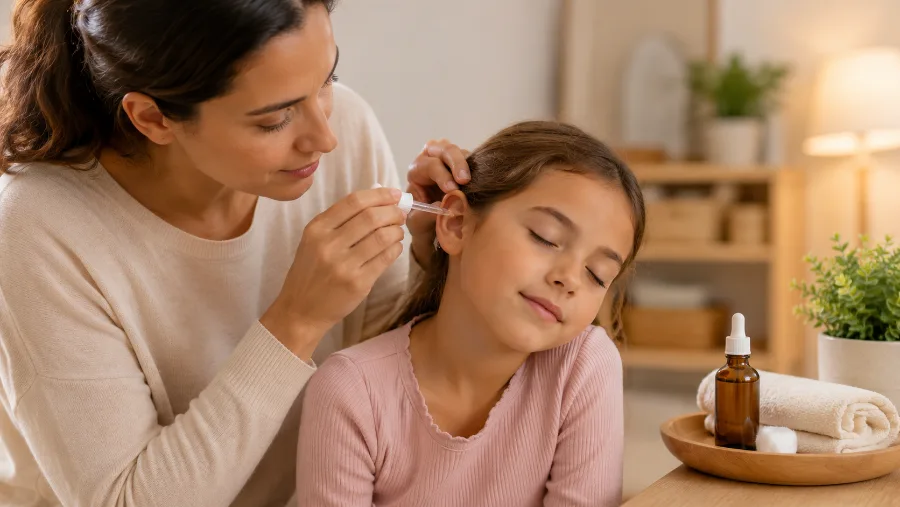
For dry earwax and everyday comfort, gentle single-oil drops are the child-friendly option: mineral oil, coconut oil, or olive oil. Avoid hydrogen peroxide, carbamide peroxide, and alcohol-based drops for routine use in children — the bubbling and stinging are hard on small, sensitive ear canals. Auil ear drops by Oto Anthro are simple, purpose-made single-oil drops that can be used after swimming or as part of regular aural hygiene. Plain oils of this kind have a good safety record on children’s skin: an eight-week randomised, double-blind trial in 117 children with atopic dermatitis applied virgin coconut oil and mineral oil topically without significant adverse effects,6 and reviews of the infant skin barrier describe mineral oil as a stable, well-tolerated emollient.7 That evidence is about skin rather than the ear canal, so the usual caution still applies — do not put drops in a child’s ear if they have ear tubes, a known eardrum perforation, or recent ear surgery, and check with your pediatrician or an ENT if you are unsure.
Disclosure: Dr. Stramiello is the founder of Oto Anthro (Otolaryngological Anthropology), the company that makes the Auil ear drops shown below, and SafeEarCare.com provides links to Amazon for purchase. That is a material financial relationship, and we disclose it plainly to remain transparent. The clinical guidance here does not change based on what we sell — any plain, purpose-made single oil will do the same job. Full disclosure.


A few drops at bedtime, used according to the label, is typically all it takes. Warm the closed bottle in your hands first so the drops are not cold, have your child lie on their side, and expect a little oil to work its way back out afterward — that is normal. Do not follow drops with swabs or any attempt to “get the wax out.” The oil’s job is to soften; the ear does the rest.
When Not to Use Drops at Home
Do not put any drops in a child’s ear — oil-based or otherwise — if your child has ear tubes, a known or suspected eardrum perforation, drainage from the ear, significant pain, or a history of ear surgery, unless their doctor has said it is appropriate. Small children who suddenly complain of one blocked or painful ear may also have something lodged in the canal, which needs an in-person look, not drops.
Signs Your Child Should See a Doctor
Call your pediatrician or an ENT if your child has ear pain, fever with ear symptoms, drainage or bleeding from the ear, noticeable hearing changes, dizziness, persistent tugging combined with fussiness, or a blocked feeling that does not clear within a few days. Recurrent swimmer’s ear or heavy wax buildup that keeps affecting hearing also deserves professional care rather than repeated home treatment.5
Children cannot always tell you what their ears feel like, so behavior is data: turning up the TV, asking “what?” more often, or rubbing one ear repeatedly are all worth noticing.
Teach Habits That Last
The best gift you can give your child’s ears is a set of habits they carry into adulthood: no objects in the ears, dry the outside after water, protect ears from loud noise, and tell an adult when an ear feels blocked or sore. Kids who grow up without the cotton-swab habit rarely miss it — and their ear canals are healthier for it.
Gentle, boring, consistent care wins. A soft washcloth, patience after the pool, and a simple oil-based drop when dryness calls for it will cover the vast majority of everyday kids’ ear care.
Sources
- Schwartz SR, Magit AE, Rosenfeld RM, et al. Clinical Practice Guideline (Update): Earwax (Cerumen Impaction). Otolaryngology–Head and Neck Surgery. 2017;156(1_suppl):S1–S29. American Academy of Otolaryngology–Head and Neck Surgery Foundation.
- National Institute on Deafness and Other Communication Disorders (NIDCD). Why You Shouldn’t Use Cotton Swabs to Clean Your Ears. National Institutes of Health.
- American Academy of Otolaryngology–Head and Neck Surgery. Earwax (Cerumen Impaction). ENThealth.org.
- American Academy of Otolaryngology–Head and Neck Surgery Foundation. Dos and Don’ts of Earwax (patient handout).
- Rosenfeld RM, Schwartz SR, Cannon CR, et al. Clinical Practice Guideline: Acute Otitis Externa (Update). Otolaryngology–Head and Neck Surgery. 2014;150(1_suppl):S1–S24.
- Evangelista MTP, Abad-Casintahan F, Lopez-Villafuerte L. The effect of topical virgin coconut oil on SCORAD index, transepidermal water loss, and skin capacitance in mild to moderate pediatric atopic dermatitis: a randomized, double-blind, clinical trial. International Journal of Dermatology. 2014;53(1):100–108.
- Telofski LS, Morello AP, Mack Correa MC, Stamatas GN. The Infant Skin Barrier: Can We Preserve, Protect, and Enhance the Barrier? Dermatology Research and Practice. 2012;2012:198789.
About the Author
Written and medically reviewed by Joshua A. Stramiello, MD, board-certified otolaryngologist (ear, nose, and throat physician). Last reviewed August 6, 2026.
Dr. Stramiello earned his Doctor of Medicine at the University of South Florida Morsani College of Medicine, completed his general surgery internship at Vanderbilt University Medical Center, and completed residency in Otolaryngology–Head & Neck Surgery at the University of California, San Diego. He has cared for ENT patients at Dartmouth-Hitchcock, Sanford Hospital, and West Suffolk Hospital in the UK, and his peer-reviewed research spans pediatric otolaryngology, airway surgery, and ear disease (Google Scholar).
The content on SafeEarCare.com is intended for educational purposes only and should not be considered medical advice. It is not a substitute for professional medical advice, diagnosis, or treatment. Always consult your physician or qualified healthcare provider regarding your individual health needs.
Discover more from Safe Ear Care
Subscribe to get the latest posts sent to your email.